Your neighbors are doing something tonight. Raft is how you find out.
No feed, no swiping, no scrolling. People near you post one real plan — pickleball at seven, coffee at nine, a slow run at dawn. You tap I'm in, you turn up, and you meet them in the actual room.
Three things, and you've got it.
A noticeboard for tonight.
One screen: real plans happening across your city in the next few hours, each with a time and an address. That's the whole product. Nothing to catch up on, nothing you missed.
You can't add a friend you haven't met.
Checking in at the venue is what unlocks the friend request. The list of people on your Raft is the list of people you've actually stood next to.
It wants you to close it.
There's nothing to scroll and no reason to linger. Once you've picked something, the app has done its job — fewer minutes in Raft means Raft is working.
Open it, pick something, go.
Five screens, start to finish. The last one is a door.
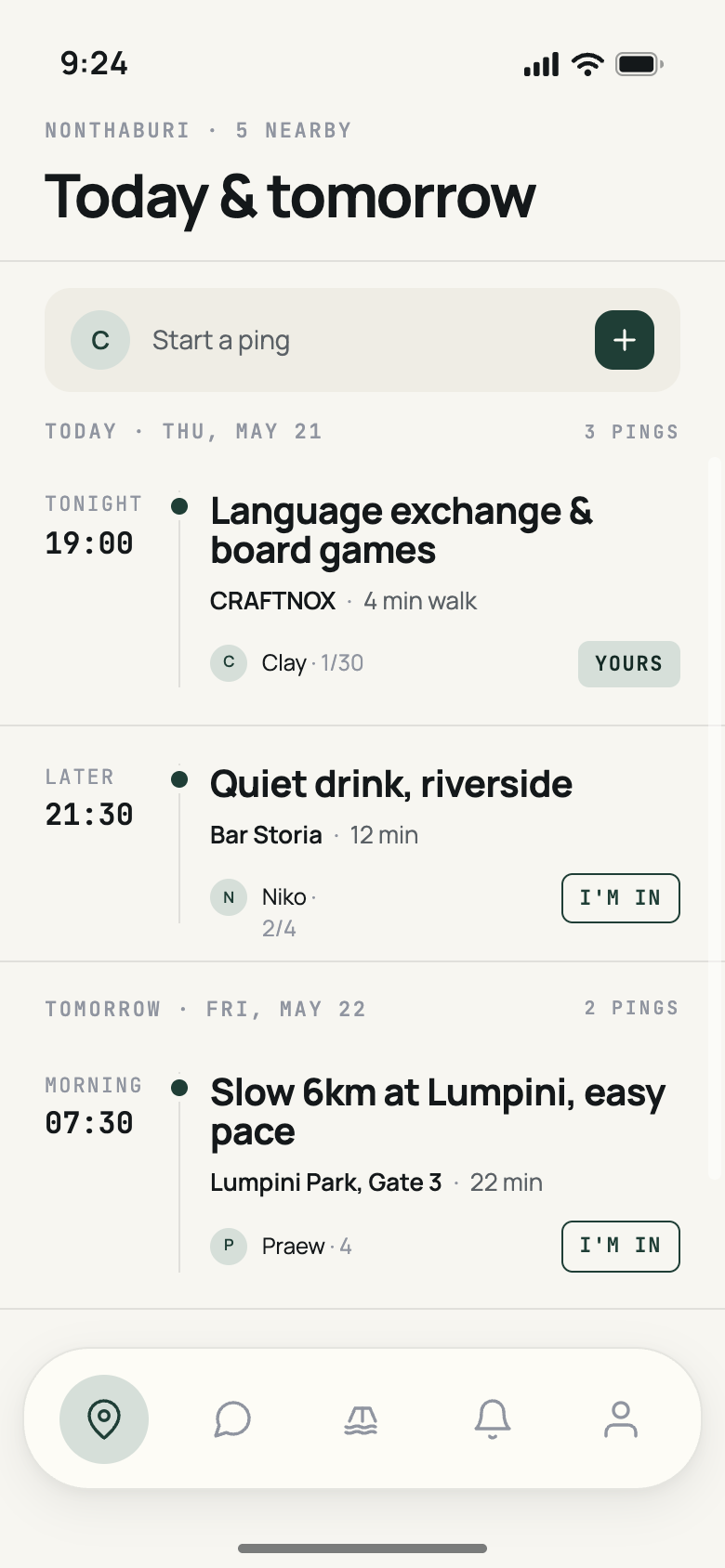
See what's on in your city tonight.
Today and tomorrow, in order, with the travel time from where you are. Your whole city, sorted by what's soonest and closest — not a directory you have to go searching through.
Each row is one plan: what it is, where, when, and how many people are in so far.
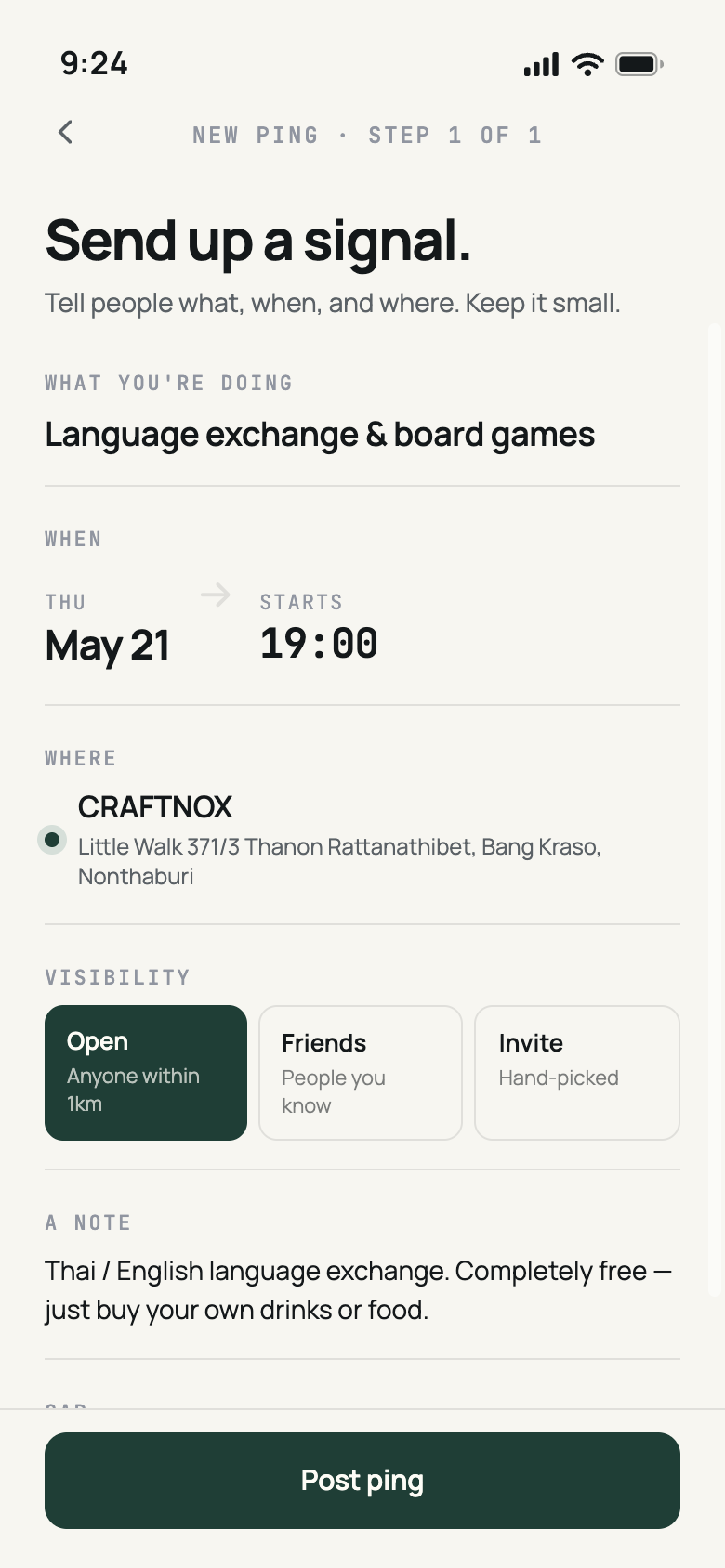
Or post your own in about twenty seconds.
A Ping is a casual broadcast: I'm doing this thing, at this place, at this time — join me. A plan, not a personal ad — capped in size, and gone when it's over.
You choose who sees it: your friends, your communities, or anyone in your city who fits.
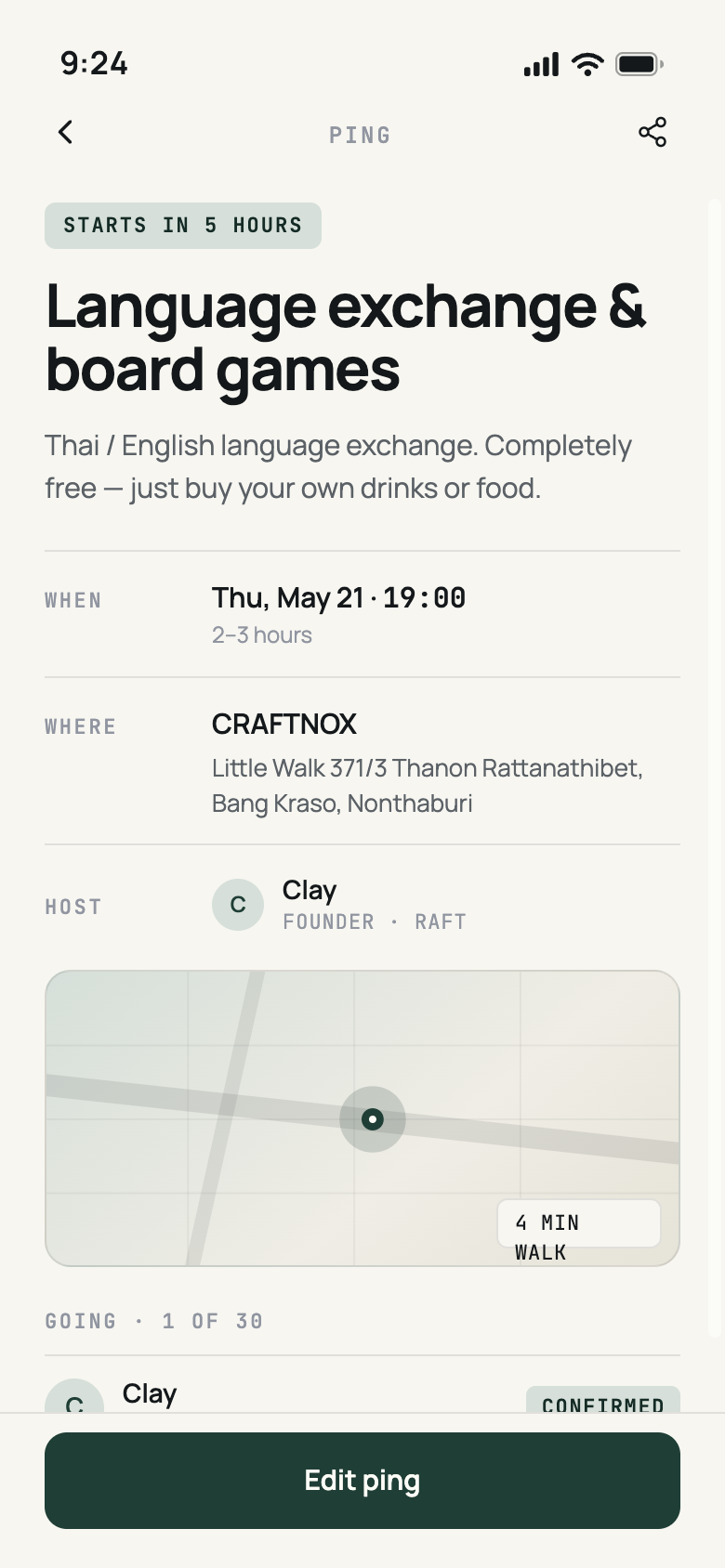
Tap I'm in. You get the address and who's coming.
The host already set the plan, so there's nothing to negotiate — no thread of maybes, no vote on the venue. Every Ping gets its own group chat for the small stuff, like who's bringing the board games, and it winds down when the Ping does.
The map, the travel time, the host, and the headcount are all on one screen.
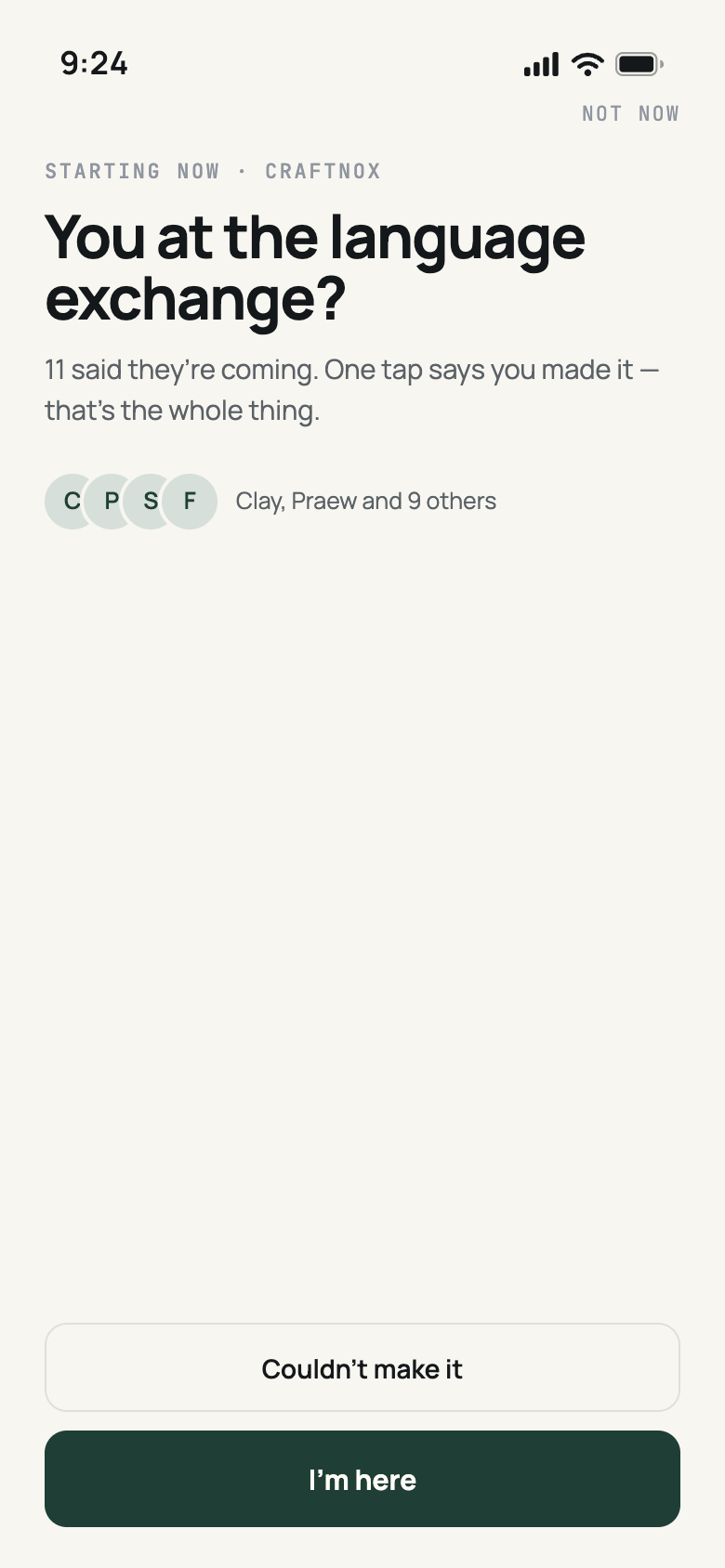
Check in when you arrive.
One tap at the venue, by QR or location. It's the only thing Raft asks of you in person — and it's the hinge the whole network turns on.
This is what unlocks adding each other. No check-in, no friend request.
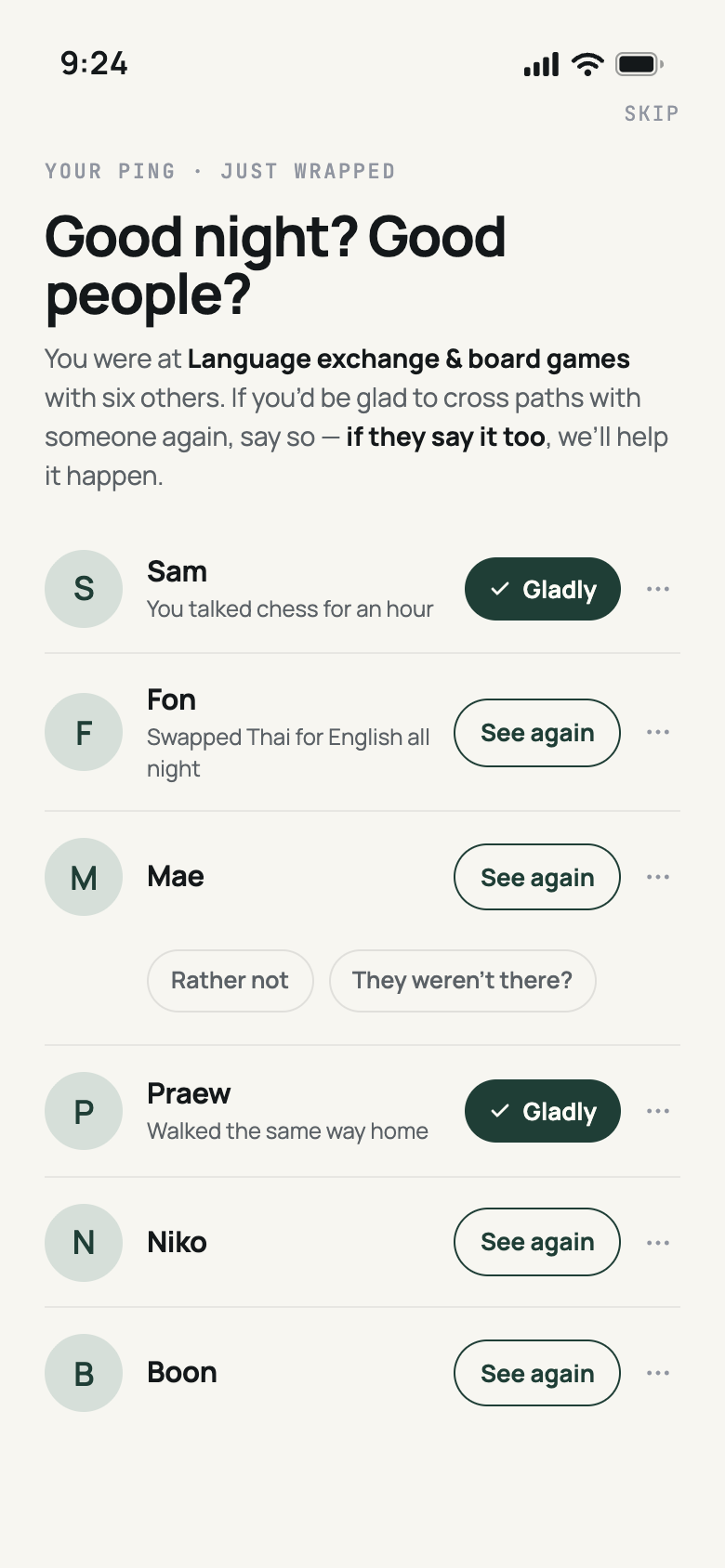
Afterward, one private question. Then it drops out of sight.
The Afterglow: who from tonight would you meet again? Your answer is never shown to anyone — it isn't a follow, it isn't a like, and the other person never knows. Hosts quietly confirm who actually came, which keeps every headcount honest.
Skipping it costs nothing. Silence records nothing.
Everything on Raft is one of these.
A Ping has four parts and no room for anything else. Structured on purpose: there is nothing here to browse, only things to attend.
The activity
Pickleball, board games, a study session, a quiet drink. Stated plainly, so you know what you're walking into.
The place
A named venue with a real address and how far it is from you — never "somewhere downtown".
The window
Now, or within the next few hours. A Ping expires. Nothing sits in a backlog waiting for you.
Who's coming
A headcount and a cap, so a group of four stays a group of four. The host is a person, verified, standing at the door.
One app, four layers. Each stands alone.
Social is the ground floor and it's what most people use. The rest sit alongside it — you can ignore them entirely and Raft still works.
Pings, Harbors and Rafts.
The coordination layer. Pings live inside scoped audiences — wider than your friends, narrower than the world.
- PingOne plan, in the next few hours. The unit everything else is built from.
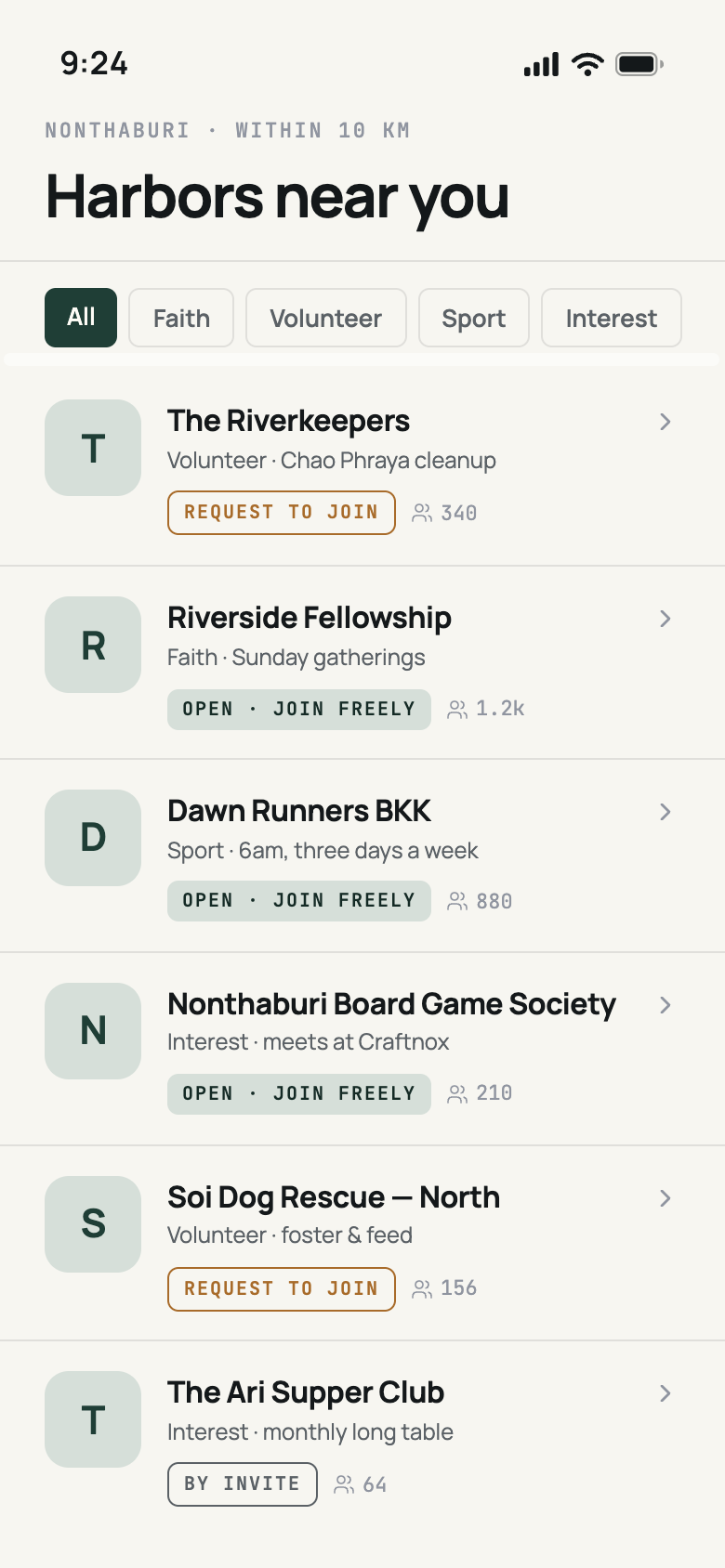
- HarborA large community shell — a city pickleball scene, a church, a campus running club.
- RaftYour small crew. Coordinate with people you already know, away from the open pool.
One match at a time.
When two people match, both leave the pool entirely. No parallel options, no hedge against intimacy.
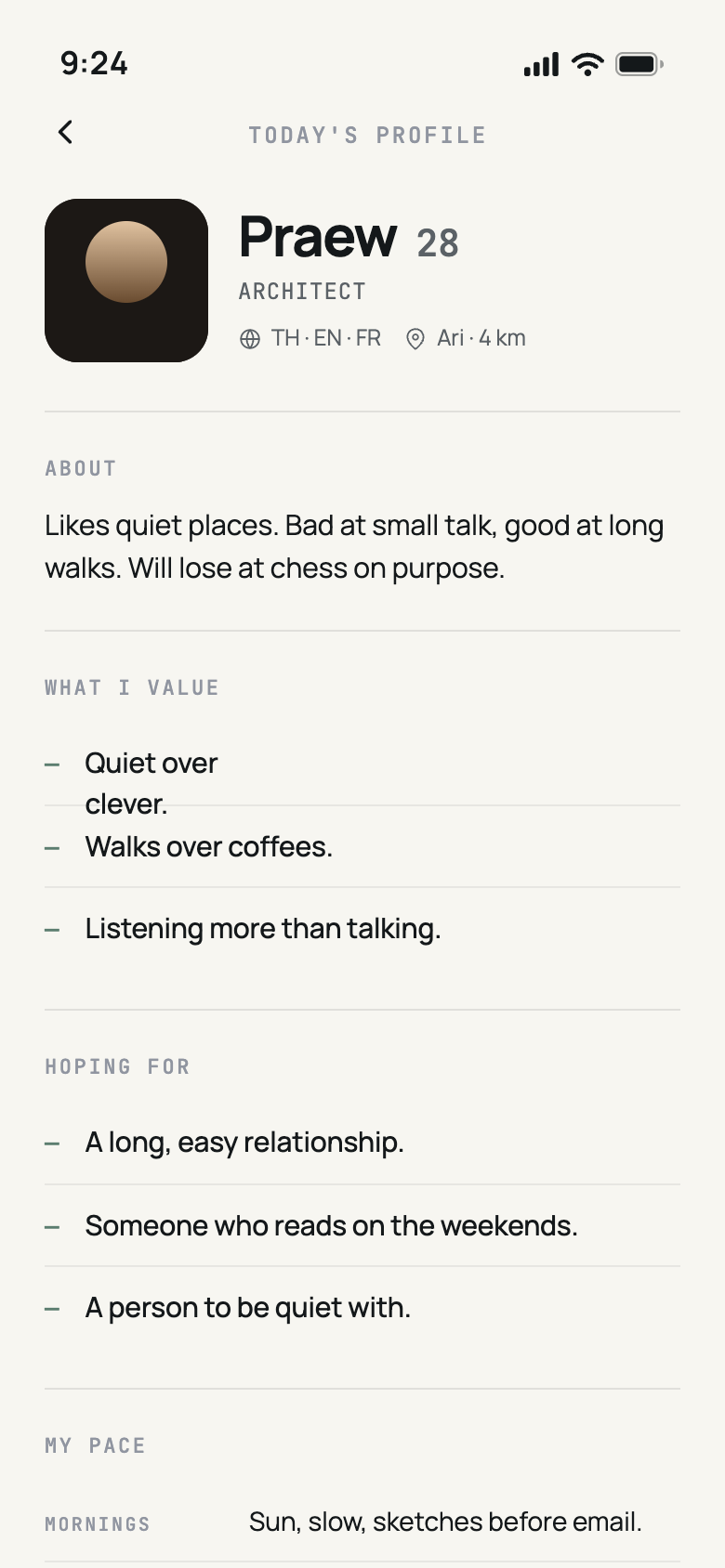
- No swipeYou read a profile end to end. Action buttons don't surface for the first ~30 seconds.
- One identityThe profile a match sees is the profile your friends see. No dating persona.
- No tiersNo boosts, no roses, no visible like counts, no paid queue-jumping.
- Price$60 once, for life — or $10/mo split over six months.
- In stagesAccess opens gradually so the pool stays balanced. Never by paying.
Show up for your corner of the world.
A concrete task, at a real place, run by a verified local you meet at the door. Read it, show up, help, go home.
- Drop inClaim one slot, lend a couple of hours. Nothing recurring, nothing owed.
- AnchorAttach to a Cause you love and it becomes a fixture on your week.
- Plain workShelter dogs, food banks, creek trails, checking on elders. No politics, no side to pick.
- QuietHours logged by check-in, known only to you and the organizer. No badges, no leaderboards.
Learn it from someone nearby.
Language, music, tennis, code, cooking — taught in person by a verified local. Run with our partner WithCoach.me, reachable without leaving Raft.
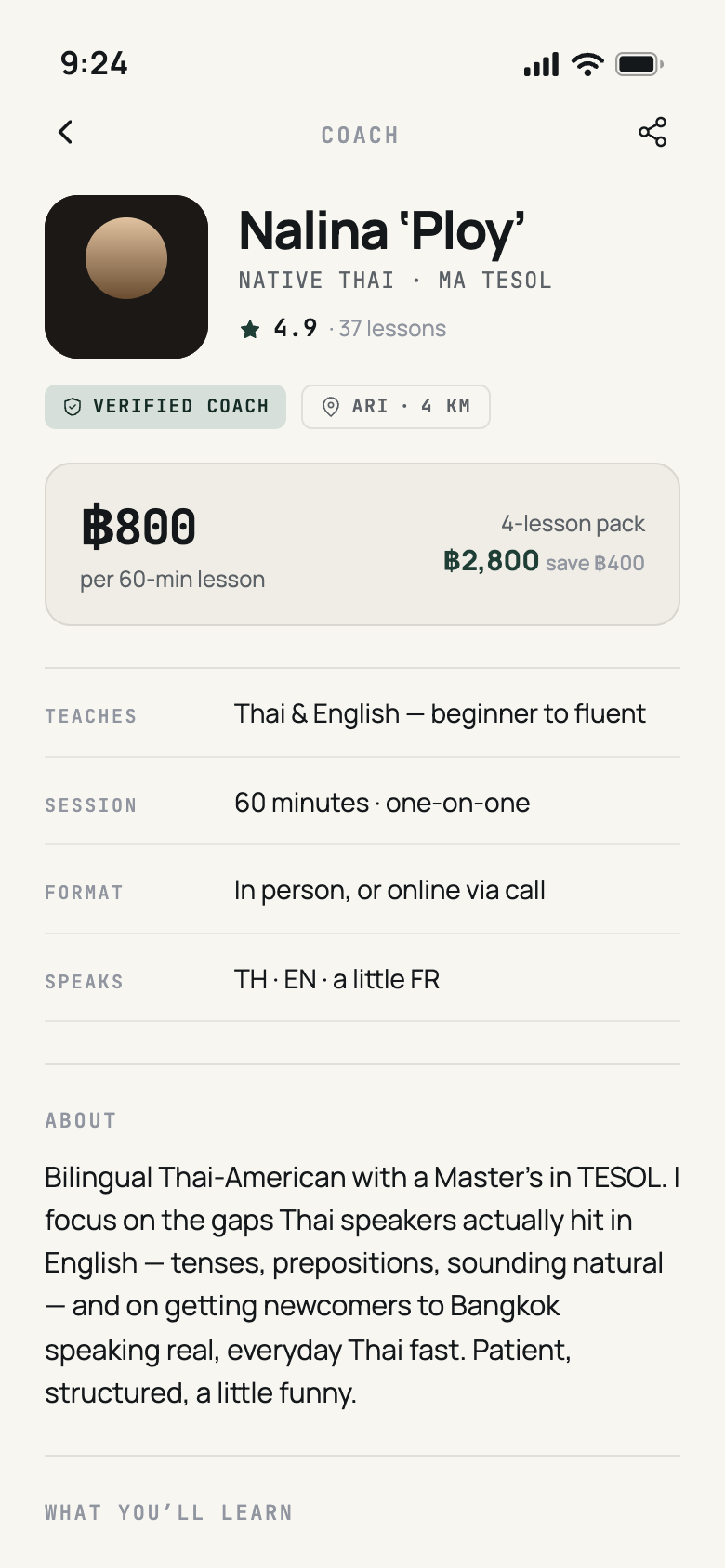
- Up frontReal rates and open slots on the page. No "message for a quote".
- ReviewsWritten by people who actually took the lesson. No pay-to-rank.
- ProtectedWithCoach holds payment until the lesson happens. Raft never touches it.
- Two-sidedAnyone can list a skill. Set your rate, get verified, teach.
- IndependentCoaches are their own business, not Raft staff. We check identity, not credentials.
"So how is this different from…"
The question everyone asks. Here it is side by side, and then in plain sentences — including the cases where you should use the other thing.
| Raft | Meetup | Timeleft & dinner clubs | nomadtable & traveler apps | Dating apps | |
|---|---|---|---|---|---|
| The unit | One plan, in the next few hours | A group that runs recurring events | A table for six, on a set night | An activity posted by someone passing through | A profile in a deck |
| Who creates it | Any member, in about 20 seconds | An organizer, running a group | The app — it picks the group and the venue | Any traveler currently in the city | The matching algorithm |
| When it happens | Tonight, or within a few hours | Scheduled, often weeks ahead | A fixed weekly slot | While you're in town | After a chat, eventually, maybe |
| Who you meet | People who actually live in your city | Whoever joined that group | Strangers matched by a questionnaire | Other travelers and remote workers | Whoever you're served |
| Verification | Government ID + selfie, before you can join anything. 18+ | None. A profile is a name and a photo | A linked social account, not an ID check | A linked social account, not an ID check | Usually optional, and rarely an ID |
| A feed to scroll? | None. There is nothing to catch up on | Listings and group activity | None | Activity lists and group chats | An endless one |
| Adding people | Only after you've checked in together | Anyone, anytime | Not in-app — you swap contacts yourself | Anyone nearby | Only through a match |
| How it makes money | Boosted Pings (real events) + one flat dating fee | Organizer subscriptions | A monthly subscription; dinner paid at the venue | Free tier plus a paid upgrade | Recurring subscriptions and boosts |
vs. Meetup
Groups vs. peopleMeetup is group-shaped. Someone starts a group, becomes an organizer, schedules events, and you browse listings to find one. It's built for institutions that run a calendar.
Raft is person-shaped. There's no group to found and none to join before you can do anything — any member posts one plan for tonight and it reaches the people nearby who'd want it. And the friend-add only opens after you've been in the same room, so what accumulates isn't a membership list, it's a circle.
Use Meetup if you want a standing 200-person interest group with a public calendar and a named organizer. Raft doesn't do that.
vs. Timeleft
Curated vs. spontaneousTimeleft is a ritual with the decisions removed: a questionnaire sorts you onto a table of six strangers, the app picks the restaurant, and it happens on its night, in whatever part of the city it lands. You pay a monthly subscription, and dinner at the venue on top.
Raft is the other six nights of the week. You choose the activity, the hour, and the place — or you join one four minutes from your door. It's free, it isn't only dinner, and the people are neighbors rather than a fresh table each week.
Use Timeleft if you want the whole evening decided for you and enjoy the mystery. Raft asks you to pick.
vs. nomadtable
Residents vs. transientsnomadtable is built around movement: see which travelers are in your city right now, post a dinner, match with people whose trip dates overlap yours. It's very good at a good week somewhere new.
Raft is built for people who live here. The measure isn't how many people you met this week, it's whether you keep running into the same faces — which is why check-in gates the graph, and why the people worth meeting are the ones who'll still be in town next month.
Use nomadtable if you're moving every few weeks and want company on the road. Raft rewards staying put.
vs. dating apps
IncentivesEvery subscription dating app has the same quiet problem: it earns more the longer you stay single. So the deck never ends, the likes are hidden behind a tier, and boosts sell you a place in the queue.
Raft's dating layer is one flat payment for life. On a match, both people leave the pool completely. There's no swipe, no visible like counter, no premium tier — and the profile is the same one your friends see, backed by which Pings you actually turn up to.
Use a dating app if you want volume and a large pool. Raft deliberately gives you one person at a time.
vs. your group chat
ReachA group chat can only ever reach the people already in it. Nobody new arrives, somebody always has to be the one who asks, and the plan itself ends up buried in the scroll instead of written down anywhere.
A Ping starts with the plan — venue, window, headcount, cap — and reaches the right slice of your city rather than the same nine people. It gets its own group chat for the details, and that chat winds down when the plan does.
Keep the group chat for the friends you already have. Raft is for widening the circle by one or two real people at a time.
vs. Facebook & Instagram
Screen timeThose apps are measured in minutes captured. The feed exists because attention is the product, and "what are we doing tonight?" was replaced by watching other people have done something.
Raft has no feed, no stories, no online-now dots, no streaks. There is no surface on which to perform, and no number that goes up. Success is meetups attended, and the only ads are invitations to a real event you can walk to.
Honestly: if you want an audience, Raft is the wrong app. Nothing here is public.
Anyone you can actually meet is a verified adult.
Meeting strangers in person only works if the door is guarded. It's the least glamorous part of Raft and the part we're strictest about.
Engineered to fail at engagement.
Every pattern on the left was a deliberate omission, not a feature we haven't got to. If Raft is boring to sit in, it's working.
- The infinite feed
- Stories and status updates
- Swiping
- Online-now indicators
- Typing indicators
- Streaks and gamification
- Public like counts
- Success measured in meetups attended, not session length
- Archive a thread and it stays out of the list until someone writes
- A private prompt after the activity — your answer is never shown to anyone
- Every Ping gets a thread that retires with the plan; your threads with friends stay yours
No incentive to keep you scrolling. Or single.
Two business models broke social: engagement ads reward addiction, and subscription dating quietly rewards your loneliness. Raft takes neither.
Posting Pings, joining them, Harbors and Rafts cost nothing, and never will. Coaching runs with our partner WithCoach.me — browsing coaches is free, lessons are paid to the coach through WithCoach, and Raft never handles that money.
The ads are Boosted Pings — a café hosting a card-game night, a bar running trivia. Always a real event you can join, never a feed of things to buy from the couch. Reach is local, so the neighborhood spot isn't outbid by a chain.
One flat buy-in, or $10/month split over six months if you'd rather. After that, nothing — no renewals, ever.
No boosts, no roses, no tiers. Once you've paid, we have no reason to keep you in the pool — which is the entire point. When you match, you both leave it.
Those two are the business model, not the whole till. Translation runs on a subscription or credit packs, you can send a gift to a match, and coaching bookings are paid to the coach through WithCoach. Prices are shown in the app before you buy.
The ones we actually get asked.
Is Raft a dating app?
Do I need friends on Raft already?
What if nothing is happening in my city?
Is this just for expats and digital nomads?
Why can't I add someone I haven't met?
How is the social side free?
What does the check-in know about my location?
Where is Raft live?
Can I get in right away?
What happened to the manifesto?
Be known by your neighbors.
Download Raft, verify, and you're in line for your city's next cohort — a friend's invite moves you up. Help build a social network you can put down.